
Having covered what not to do in my recent post on the top 5 mistakes students make in A Level Economics, let’s take a look at what you should do to secure that A/A* grade. Here’s a list of 7 tips you should follow if you want to score highly this Summer.
1. Plan your timing.
As exam time approaches, students understandably get overwhelmed with learning all the necessary diagrams, content, context and evaluation, leaving them without much time (ironically) to make exam-specific considerations, like how long to spend on each question. Those that do consider how long to spend on each question, do so, in my opinion, in the wrong way however. Rather than just acknowledging roughly how long each question should take, I recommend learning the time at which you hope to have finished each question by. Here’s a demonstration of what I mean specific to AQA (but the principle applies to all specifications):
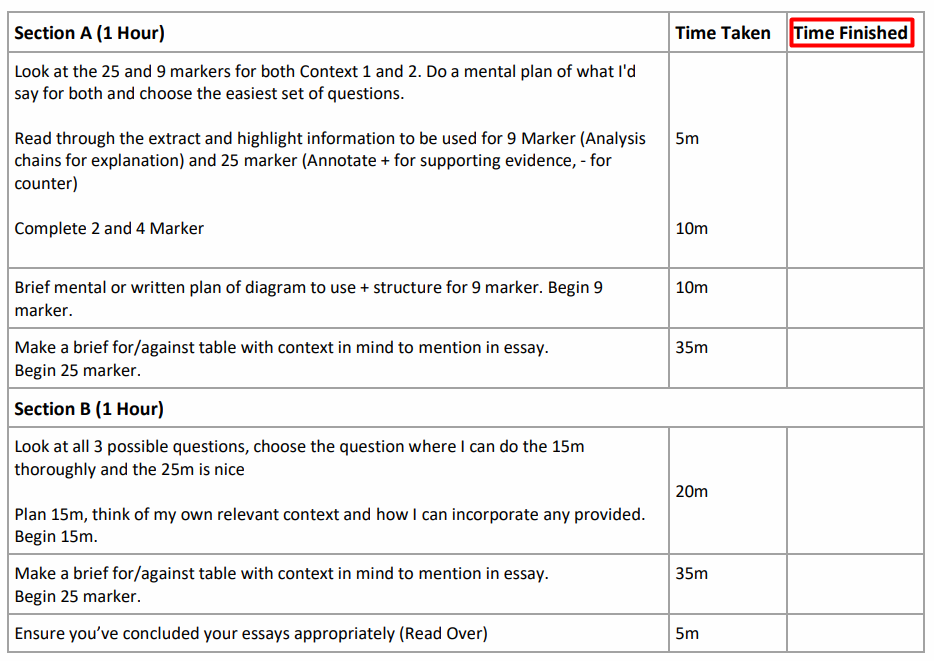
Taken from my completely free AQA Exam Question Breakdown
2. Learn context to support your analysis.
Familiarising yourself with content and understanding concepts such as dynamic inefficiency, predatory pricing, and geographical immobility of labour is one thing, examples of these concepts is another, and one which is heavily underappreciated amongst A Level Economics students. For example, a simple mention of the fact that in 2024, Apple completed the largest share buyback scheme in history at $110bn, bringing their total share buyback expenditure to $395bn since 2019, whilst also raising their dividend by 4%, helps to demonstrate that high levels of supernormal profit are often used to prioritise shareholder satisfaction through rising share prices and dividends, rather than prioritise consumer satisfaction through reinvestment in cost-cutting technology and R&D. Similarly, awareness of Temu as an example of a firm engaging in predatory pricing (having been reported to lose upwards of $1bn annually), and awareness of HS2’s cancellation being a potential contributor to geographical immobility of labour, all help to strengthen your essays and bring them to life. I’d strongly recommend either taking the time out to learn examples of different concepts, or if exams are approaching and you want to prioritise learning content, evaluation and diagrams, then the 2026 Context Pack might be for you.
3. Always reference the multiplier when mentioning an injection or withdrawal
Whenever you get an injection into or withdrawal from the circular flow of income, you should include the positive/negative multiplier effect, respectively, in your analysis. Below I’ve included a model paragraph demonstrating how you can incorporate the negative multiplier effect into an essay about the consequences of an appreciation in the pound.
Model explanation of negative multiplier effect due to appreciation (dearer exports):
Appreciation → Imports cheaper & exports dearer → Reduction in international competitiveness → Reduced export revenue & increased import expenditure → Net withdrawal from the UK circular flow of income → Negative multiplier effect because:
A reduction in export revenue reduces profits for firms, meaning the productivity benefits which would have come as a result of this profit being invested in areas such as cost-cutting technology, research & development, increasing wages for workers or hiring more workers, are missed out on as this profit is lost. For example, if there is a £100m reduction in export revenue, the UK economy has £100m less to be allocated to areas of investment or innovation which would have generated productivity improvements (potentially worth £10m) and contributed to expanding the UK’s productive potential, as well as contributed via demand side benefits due to increased cyclical and structural job creation and tax revenue generation.
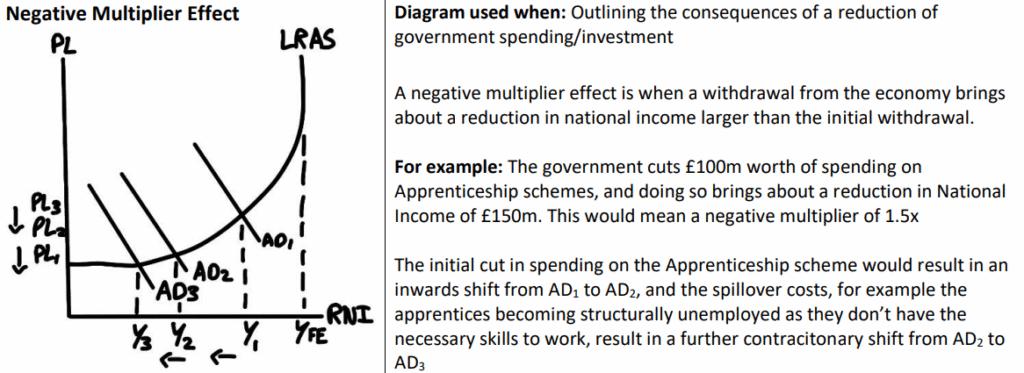
This negative multiplier effect, along with an explanation of where and how it can be used, can be seen on the above diagram, taken from the Diagram Explanation Bundle.
4. Mention an area where raised tax revenue can be allocated which is relevant to the question
Oftentimes policies which have implications for tax revenue and the governments budget, whether a tax, subsidy or even entry of FDI into a country are discussed, but students rarely go on to mention what exactly these implications are for the governments budget. For example, a tax on cigarettes will raise revenue for the government, and so it’s important to discuss in your essay how this tax revenue can then be used. It’s equally important however that the suggested use of the tax revenue is relevant to the question, as many students fall into the trap of saying that a tax on cigarettes can be used to invest in infrastructure or areas irrelevant to the topic area, when instead they should suggest a relevant use case, such as tax revenue being used to subsidise nicotine patches for smokers. When a tax is used to subsidise other areas, this is called a hypothecated tax. Another example of a hypothecated tax might be using tax revenue raised from tariffs to subsidise cost of production for domestic exporters to further boost international competitiveness.
5. Important considerations when evaluating
There’s primarily two important considerations when evaluating a policy. 1. Does it do what it intends to do, and 2. Are there any side effects or unintended consequences. For example, if we were assessing whether chemotherapy was beneficial for a patient, we’d assess 1. Does it destroy the cancer and therefore is it effective, and 2. Are there any unwanted side effects that we need to be aware of. These 2 questions determine the overall benefit for the patient. The same approach needs to be taken for treatments (policies) in Economics. For example, when evaluating a sugar tax, we need to ask ourselves is it effective, i.e does it reduce sugar consumption, (to which you might respond to some extent but not as much as we’d hope because demand for sugar is price inelastic) and are there any unintended consequences, to which you might claim yes, because a sugar tax is regressive as it hits low income consumers who rely on cheap unhealthy foods. By appreciating the efficacy of the policy and its unintended consequences, we get a much better picture of the overall impact of the policy and whether it has a net benefit or can be considered an example of government failure.
An important consideration when assessing the efficacy of the policy itself is whether or not it addresses the root cause of the issue. For example, if sugar consumption is driven by the fact that sugar is cheap (which partially it is) then a sugar tax is likely to be somewhat effective, whereas if the primary root cause of the issue is information failure and bounded rationality, i.e consumers are ignorant of the harms of high sugar consumption, then behavioural policies like education may be more appropriate than traditional economic policy. This technique applies to all policies, for example the question surrounding the efficacy of protectionism partially relies on whether or not it addresses the root cause of lacking international competitiveness. Arguably, tariffs fail to address the reason as to why domestic producers can’t export goods at a lower price than their international competitors, whereas subsidies may facilitate the investment required for firms to compete at lower prices and thus better address the root cause.
6. Structuring a question on government intervention
When answering a question on government intervention, the structure I’d always recommend is as follows:
- Brief introduction defining any relevant key terms (E.g it might help to define externalities or demerit/merit goods for a question on partial market failure)
- Justification of government intervention (Diagrams are particularly relevant here)
- Evaluation of government intervention
- Conclusion
For some reason many students struggle when structuring responses on government intervention as they obsess over a structure involving point for, point against, when actually the most important thing is to first justify government intervention, often using a diagram, and then move onto your evaluation, ensuring you include the considerations we discussed in tip 5.
7. Squeeze your lemons
Last but not least, when writing out your chains of analysis, don’t leave them unfinished. An analogy I use with my students is to treat your points as lemons which you need to squeeze as much detail as possible out of. For example, if discussing the consequences of a depreciation in the exchange rate, it wouldn’t be appropriate to say that a depreciation may increase inflation, and just leave it there. Instead, it’s crucial to dive into why a depreciation would contribute to inflation (demand and supply side factors) and then ask yourself why is this bad. Instead of leaving it at a depreciation causes inflation, expand further on the consequences this has on the macroeconomy, for example increased import prices following a depreciation may contribute to upstream rises in cost of production which reduce international competitiveness and offset a reduction in the price of exports caused by the depreciation.
So that concludes my blog post on 7 tips which you should follow to maximise your chances of achieving those top grades in summer. Hopefully you found it useful and best of luck for your exams! If you’re looking for that extra boost as exam season approaches, I offer 1-1 Tuition services here 🙂 Stay tuned for more blog posts